Property Tax in Poland: What a Warsaw Flat Owner Actually Pays
Author: Stanisław Nawrocki, real estate agent · Nawrocki Real Estate, Warsaw
Published · Updated
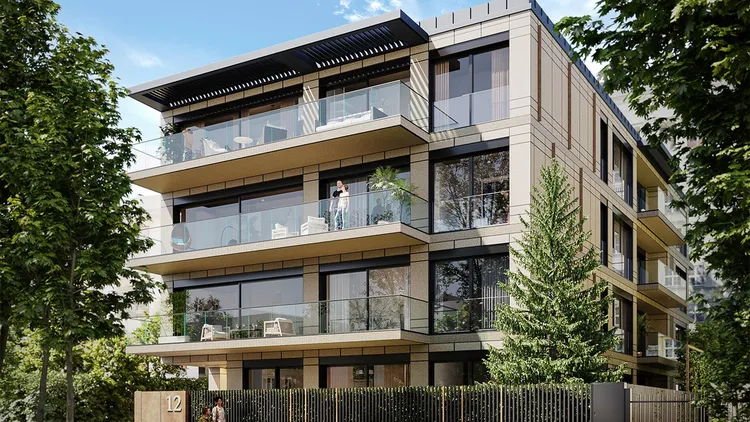
Property tax in Poland (podatek od nieruchomości) is a local tax that a flat owner pays every year to the city: in Warsaw the city council sets the rate per square metre of usable floor area, and you learn the amount from a tax decision issued by the city office. It is only one of several taxes linked to a flat, though: on purchase you pay VAT inside a developer's price or 2% PCC on a resale flat, on rental income a flat-rate tax of 8.5%, and on a sale within 5 years a 19% income tax may apply.
Which taxes apply to owning a flat in Poland
Many expats search for a single "property tax", but in practice a Polish flat creates four tax moments: buying, owning, renting out and selling. Each has its own legal basis, its own collector and its own deadlines. The table below sets out what an individual buying a flat in Warsaw really pays.
| Moment | Tax or fee | Rate | Collected by |
|---|---|---|---|
| Buying from a developer | VAT included in the price | 8% up to 150 m² of usable area, 23% on the excess | developer, inside the price |
| Buying a resale flat | PCC (podatek od czynności cywilnoprawnych, tax on civil-law transactions) | 2% of market value | notary |
| Land register entry | court fee | 200 PLN for ownership, 200 PLN for a mortgage | notary |
| Mortgage loan | PCC on the mortgage | 19 PLN | notary |
| Owning | podatek od nieruchomości | rate set by city council resolution | city office, by tax decision |
| Private rental | ryczałt (flat-rate tax on revenue) | 8.5% up to 100,000 PLN a year, 12.5% above | tax office |
| Selling within 5 years | PIT (personal income tax) | 19% of the income | tax office |
Source: Polish tax law as of 2026-11-18; local property tax rates depend on the resolution for the given year.
Only podatek od nieruchomości is paid every year simply because you own the flat. The others are one-off taxes triggered by a specific transaction, so budget for them together with the purchase price rather than discovering them at the notary's office.
Podatek od nieruchomości: who pays it and how it is assessed
The tax is governed by the Act on local taxes and fees (ustawa o podatkach i opłatach lokalnych), and the money goes to the city budget. The taxpayer is the owner of the flat; where there are several owners, such as spouses, they are jointly and severally liable. Citizenship and residence status do not matter: a foreign owner pays on exactly the same terms as a Polish one, whether or not they live in Poland.
For new-build buyers there is an important detail. The obligation does not start when you sign the umowa deweloperska (developer agreement, under which the developer undertakes to build the flat and transfer ownership to you). It starts only after ownership is transferred by notarial deed. Until then, the developer pays the tax on the building and land.
The tax base has two parts:
- the residential part of the building — calculated on the usable floor area of the flat (powierzchnia użytkowa), measured along the inner walls; rooms with a reduced ceiling height count partly or not at all, so attic flats often have a smaller base than their floor plan suggests;
- the land — your share of the plot under the building, attached to the flat as part of the common property; where the land is held in użytkowanie wieczyste (perpetual usufruct, a long-term right to use land owned by the city or the State Treasury), the usufructuary is the taxpayer.
Storage units, parking spaces in an underground garage and commercial premises may be taxed differently from the flat itself. If you buy a parking space as a separate unit or as a share in the garage, check in the tax decision how the city has classified it.
Rates in Warsaw, the tax decision and payment deadlines
The Warsaw City Council (Rada m.st. Warszawy) sets the property tax rates every year by resolution (uchwała). They cannot exceed the maximum rates that the Minister of Finance announces for the following year, so always look at the resolution for the year you are paying for. We deliberately give no amount here: the rate changes every year and depends on the type of premises. Current information on local taxes and forms is published in the city's Public Information Bulletin (Biuletyn Informacji Publicznej) and on the national tax portal podatki.gov.pl.
The procedure for an individual looks like this:
- after buying, you file an information return on property (informacja o nieruchomościach i obiektach budowlanych) with the city office within the statutory deadline counted from the date of acquisition;
- the tax obligation starts on the first day of the month after the month in which you became the owner, so for the first year the tax is charged pro rata;
- the city issues a tax decision (decyzja) stating the amount, usually at the start of the year, or after you file the information if you bought during the year;
- the tax is paid in instalments on the dates in the decision, or in one payment if the amount is small.
Land is a separate matter. Many Warsaw buildings stand on land that was held in perpetual usufruct and was converted into ownership by law. In that case you pay a conversion fee (opłata przekształceniowa) on top of the tax, and where no conversion took place, an annual perpetual usufruct fee. These are not taxes, but they are a real running cost. Before buying, check the land and register records for the flat and the plot in the Elektroniczne Księgi Wieczyste system and ask the building manager what is included in the monthly service charge (czynsz).
Taxes on purchase: VAT from a developer or PCC on resale
The largest one-off tax comes at purchase and depends on the market. Buying from a developer, you do not pay PCC: the price includes VAT, which under the Polish VAT Act is 8% for usable area up to 150 m² and 23% on the excess. A parking space or storage unit sold as a separate unit is usually taxed at 23%, so compare the price of the whole package, not just the flat.
On the resale market the notary collects 2% PCC on the market value under the Act on tax on civil-law transactions. Since 2023 a buyer of a first own flat on the resale market can be exempt if the statutory conditions are met; how property you own abroad is treated should be confirmed with the tax office before the deed. We explain the conditions in our guide to the PCC exemption for first-time buyers in Poland.
| Resale flat price | PCC 2% | Ownership entry in the land register | PCC on the mortgage |
|---|---|---|---|
| 500,000 PLN | 10,000 PLN | 200 PLN | 19 PLN |
| 800,000 PLN | 16,000 PLN | 200 PLN | 19 PLN |
| 1,200,000 PLN | 24,000 PLN | 200 PLN | 19 PLN |
Source: NAWROCKI cost examples based on statutory rates as of 2026-11-18; notary fee not included.
On top of that comes the notary fee (taksa notarialna). The Minister of Justice's regulation sets only a maximum, so the fee is negotiable, and 23% VAT is added to it. For the complete list see our full breakdown of buying costs and taxes in Poland.
To put these amounts in context, here are prices from notarial deeds:
| District | Median price per m², new-build | Median price per m², resale | Median new-build flat price |
|---|---|---|---|
| Białołęka | 12,482 PLN | 13,672 PLN | 574,793 PLN |
| Ursus | 12,773 PLN | 14,766 PLN | 596,946 PLN |
| Bemowo | 13,624 PLN | 15,809 PLN | 660,707 PLN |
| Włochy | 14,308 PLN | 16,151 PLN | 678,714 PLN |
| Praga-Południe | 15,707 PLN | 15,932 PLN | 744,923 PLN |
Source: RCN (Rejestr Cen Nieruchomości, the official register of transaction prices), NAWROCKI analysis, transactions registered from 2024-11-18 to 2025-12-19.
In these districts the median resale price per m² is higher than the developer median, and a resale purchase adds PCC on top. You can check a single district on the page with RCN transaction prices in Włochy.
Renting the flat out: flat-rate tax on revenue
If you buy to let, podatek od nieruchomości is still charged under the residential rules as long as the tenant uses the flat as a home. Income from private rental is taxed with ryczałt under the Act on flat-rate income tax: 8.5% of revenue up to 100,000 PLN a year and 12.5% above that. The tax is charged on revenue, not profit, so the service charge, renovation and mortgage interest cannot be deducted.
Points worth knowing:
- the rental tax is paid during the year, and an annual return is filed after the year ends;
- spouses renting out a jointly owned flat can report the income through one of them by filing a statement;
- short-term letting with extra services may be treated as a business activity, which changes how it is taxed and possibly the property tax rate too.
If you live abroad, rental income from a Warsaw flat is generally taxable in Poland, and your home country may also tax it under its own rules and the relevant tax treaty. Run the numbers after tax, not before, and agree the approach with a tax adviser (doradca podatkowy) before you buy.
Selling within 5 years: PIT and the housing relief
The tax on a sale is the one that surprises people most. Under the Personal Income Tax Act, if you sell a flat before the end of 5 calendar years counted from the end of the year of purchase, you pay 19% PIT on the income. The income is the sale price minus documented acquisition costs: the price, PCC, notary costs and improvements backed by invoices.
You can avoid the tax in full or in part through the housing relief (ulga mieszkaniowa) by spending the proceeds on your own housing needs within 3 years, for example buying another home, repaying a housing loan or renovating your own home. Each option has its own conditions.
Watch out for these details:
- the date that counts is the transfer of ownership, not the umowa deweloperska, so for a new build the period runs from the year of the notarial deed;
- for an inherited flat, the date on which the deceased acquired it generally counts;
- the intention to use the relief must be shown in the annual return for the year of the sale.
More examples are in our article on capital gains tax on property in Poland. If you plan to leave Poland, discuss your tax residence at the time of the sale with an adviser well in advance.
Step by step: your tax obligations after buying
- Before signing, establish whether you are buying from a developer (VAT in the price) or on the resale market (2% PCC), and whether the first-flat exemption could apply.
- Ask the notary for the draft deed and a cost calculation: the fee with VAT, PCC, court fees for land register entries and PCC on the mortgage.
- Check the land register (księga wieczysta) for the flat and the plot: who the owner is, whether the land was in perpetual usufruct and whether any entries affect costs.
- After the deed, file the property information return with the city office within the deadline, giving the usable floor area.
- Check the tax decision: confirm the area and the classification of each unit (flat, parking space, storage) and put the instalment dates in your calendar.
- If you let the flat, keep a revenue record from the first tenancy agreement and pay ryczałt on time.
- Keep the purchase documents and fit-out invoices: you will need them if you sell within 5 years.
Common mistakes and risks
- A budget without transaction taxes. On a resale flat priced at 800,000 PLN, 2% PCC means 16,000 PLN that usually has to come from your own funds.
- No information return filed with the city. It does not cancel the tax, and arrears grow with interest.
- Confusing the umowa deweloperska with the ownership transfer when counting the period after which a sale is free of PIT.
- Forgetting the land fee, conversion or perpetual usufruct, in running costs.
- A parking space at 23% VAT — when comparing offers, price the whole package, not only the flat.
- Undeclared rent — unpaid ryczałt means interest, and the tax office has many data sources.
- Working from a room in the flat without checking whether it changes the property tax rate.
Each of these mistakes usually costs more than a consultation with a notary or tax adviser. In a non-standard situation, such as co-ownership, buying through a company, property abroad or a change of tax residence, ask a specialist before you sign.
How NAWROCKI Real Estate helps
NAWROCKI Real Estate works as a buyer's agent for new-build flats in Warsaw. We compare offers from many developers at once, so you see straight away which prices include the parking space and storage unit and which add them separately at the higher VAT rate. We check the developer's price per m² against real notarial transactions (RCN) in the district. We read the umowa deweloperska and the information prospectus, negotiate price and terms with the developer, keep track of the payment schedule and help with the technical acceptance of the flat (odbiór techniczny).
In most developments we work with, the developer pays our fee, so for the buyer the service is usually free. If that is not the case, we tell you before we start. Tax decisions for your own situation should always be confirmed with a notary or tax adviser.
Planning to buy in Warsaw and want to know the full cost, including price, taxes and fees, before you sign? Contact NAWROCKI Real Estate to talk it through.
This article is general information, not legal, tax or financial advice. Consult a notary, lawyer, tax adviser or mortgage broker before making a decision.
Sources
- Ustawa z 9 września 2000 r. o podatku od czynności cywilnoprawnych (ISAP)
- Ustawa z 11 marca 2004 r. o podatku od towarów i usług (ISAP)
- Ustawa z 26 lipca 1991 r. o podatku dochodowym od osób fizycznych (ISAP)
- Ustawa z 20 listopada 1998 r. o zryczałtowanym podatku dochodowym (ISAP)
- Elektroniczne Księgi Wieczyste — Ministerstwo Sprawiedliwości
- Krajowa Administracja Skarbowa — podatki.gov.pl
Frequently asked questions
Do foreigners pay property tax in Poland?
Yes. The obligation depends on owning the flat, not on citizenship or residence, so a foreign owner files the same information return and pays on the same terms. Income tax questions, such as rental income or tax residence, are separate and worth checking with a tax adviser.
When does property tax start on a new-build flat?
On the first day of the month after you become the owner by notarial deed. Signing the umowa deweloperska does not create the obligation; the developer pays until ownership is transferred. After the deed you must file the information return with the city office.
How much is property tax on a flat in Warsaw?
The Warsaw City Council sets a rate per square metre of usable area each year, within the maximum announced by the Minister of Finance. You will see the amount for your flat in the tax decision from the city office. Tax on your share of the land is added to the tax on the flat.
Is there PCC when buying a new flat from a developer?
No. A developer's price includes VAT: 8% for usable area up to 150 m² and 23% on the excess. The 2% PCC applies only to resale purchases and is collected by the notary.
How is rental income from a Warsaw flat taxed?
Private rental is taxed with a flat-rate tax on revenue: 8.5% up to 100,000 PLN a year and 12.5% above that. Costs cannot be deducted. Owners living abroad should also check how their home country treats this income.
When can I sell a flat in Poland without income tax?
After 5 calendar years counted from the end of the year of purchase, the sale is free of PIT. Before that you pay 19% on the income unless you spend the proceeds on your own housing needs within 3 years. Speak to a tax adviser before selling.
Districts in this article — check the data
This article in other languages: Polski · Русский · Українська · Deutsch · Español · Türkçe
Read also
- Buying a Resale Apartment in Warsaw: Prices, Checks and StepsWhat a second-hand flat in Warsaw really costs, what to check in the land register, which costs come on top of the price and when a new build is the better deal.
- Capital Gains Tax on Property in Poland: the 5-Year Rule ExplainedSelling a flat in Poland within five years? How the period is counted, what reduces the taxable gain, how the housing relief works and where the rules are disputed.
- Warsaw Apartment Prices 2026: What Buyers Really Pay by DistrictHow much does a flat in Warsaw cost in 2026? Real transaction prices per m² by district, developer price lists and NBP averages, with the Polish terms explained.
Flats matched to your budget
We'll match new-build flats to your budget
Pick a budget and a district to see current offers from developers right away. Add your e-mail and we'll send the link too.